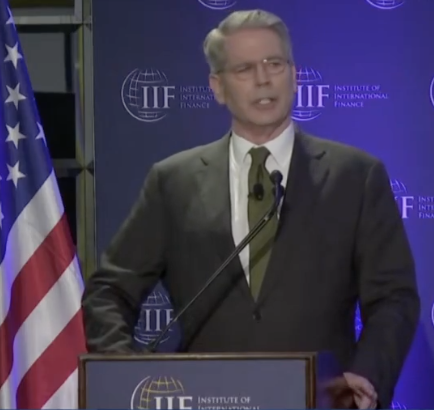
Sunday morning the Treasury secretary put a date on it. About fifteen million barrels of Iranian oil still on the water. Final deliveries to China in the next two weeks. After that, he said, they will have nothing left to trade for anything. An empty set. That is why they want a deal.
He has been saying collapse since August. This time he attached a calendar. The calendar is about tankers. The word people heard was the regime. Those are not the same sentence.
What he actually said
Scott Bessent sat with a Sunday host and described a squeeze that began as a shooting war on February 28 and turned, after the June paper fell apart, into a blockade and a sanctions drive he named Operation Economic Outcast. On August 24 he rolled out sectoral measures on gold, digital assets, aviation, shipping, and technology, plus a round of designations on ships and middlemen. The theory was simple. Stop the oil. Stop the work-arounds. Starve the Guard.
Sunday’s version was more precise. The United States is not letting Iranian barrels out of the Gulf. What is still floating outside the line is the remnant of earlier loadings, already spoken for in Asia. When those cargoes discharge, the last checks arrive on a lag of a month or two. Then the seaborne oil account goes dark.
On the strait he was blunt. Tehran offered to “open” Hormuz in seven days if Washington unfroze money and lifted the blockade. Bessent said the waterway is already open. He put non-Iranian flows at fifteen to twenty-two million barrels a day against about twenty million before the war. Take out the one and a half to two million that used to be Iran’s. Scoreboard, as he told it: more than a billion barrels out under American protection, Iran zero.
🚨🇺🇸🇮🇷 Sec. Bessent predicts Iran’s economy will collapse “probably within the next 2 weeks.”
“They’re going to make their final deliveries of oil to China, and then they will have NOTHING.”
He went on to argue that Iran is getting DESPERATE for a deal, and that promises to…
— Mario Nawfal (@MarioNawfal) September 27, 2026
The oil part he is getting right
The blockade that went back on in mid-July did what years of paper sanctions did not. Trackers of tankers have not seen a successful Iranian crude cargo through Hormuz since that date. August loadings at the terminals fell to the neighborhood of 220,000 to 260,000 barrels a day, against roughly 1.7 million a year earlier and about two million in the last full month before the war. Some of that oil never left the Gulf at all. It sat. It was shut in.
Floating storage west of the line rose as barrels piled up inside the trap. Storage east of the line, the stuff China can still reach, shrank. One August tally had total Iranian crude afloat down from about 135 million barrels to 107 million, with the accessible pile outside the blockade falling from around 105 million toward 80 million and then lower as committed cargoes were sold. Fifteen million barrels still on the water is a plausible last slice. Two weeks is a plausible sailing time for what is left.
China was taking about 1.4 million barrels a day of Iranian crude last year, more than four-fifths of what Tehran shipped by sea. By August those arrivals were running near half a million on some counts. The independent refiners who drank the cheap barrels have been looking at other grades. That is not a rumor. That is a customer walking away because the warehouse is emptying.
So the two-week clock on the last deliveries is not fantasy. If no new Iranian tanker beats the blockade, the seaborne tap really does run dry on something like that schedule. A government that lived on discounted oil to one buyer is about to live on whatever it can print, smuggle, or dig out of a frozen account it does not control.
The leap he is making
Nothing left to trade is a phrase. It is not a balance sheet.
Iran still burns oil at home. It still has a population of roughly ninety million that can be taxed, squeezed, and paid in a collapsing currency. The rial has been through the floor — past two million to the dollar on some autumn prints, against about a million a year ago. Official output in the spring quarter was down 10.1 percent from a year earlier, with oil and gas down 26.4 percent. Inflation has been running in the sixties and seventies. Pharmacies are short. That is a ruined civilian economy. It is not, by itself, a state that vanishes on October 12.
This regime has eaten worse winters. It fought Iraq for eight years. It lived under sanctions for a generation. It buried a supreme leader in the opening week of this war and put his son in the chair. The Guard still holds the guns, the smuggling shops, and the courts. A treasury secretary can close a port. He cannot, from a television studio, dissolve a security service that has spent forty years practicing how to be hungry and still in charge.
There is also the lag. Oil that docks in China in mid-October still throws off payment into November and December. Gold, crypto, and the remaining gray houses were targeted in August. Targeting is not the same as a lock on every door in Hong Kong and the Gulf. If the big Chinese banks are not actually cut off — and the August rollout was a warning shot more than a burial — some residual trade continues. Overland drips and dark ships with their beacons off have a way of appearing in this business. Zero leakage is a briefing phrase. Leakage is a profession.
Bessent has been promising collapse since late summer. First it was the toughest sanctions in history. Then weeks or months. Now two weeks, attached to the last tanker. Each time the military war failed to produce a surrender, the economic war inherited the same certainty. Certainty is useful at a table. It is not a forecast.
Hormuz, open and not open
Both sides are telling a story about the same water.
Iran says it will open the strait in a week if it gets its money and its oil. That implies the strait is closed. Bessent says it is open and the only oil locked in is Iran’s. That is the wartime definition. Neighbors are moving crude by pipeline to the Red Sea and Fujairah, by ship-to-ship transfers in the Gulf of Oman that have run in the millions of barrels a day, and by tankers that turn their public trackers off and take the southern lane under escort. Visible commercial traffic is a fraction of the old 125-to-140 ships a day. War-risk premiums have been multiples of the peacetime rate. Container lines rerouted months ago.
So he is right that the world is not living on a complete Hormuz shutdown, and right that Iranian barrels are the ones that stopped. He is stretching when he makes fifteen to twenty-two million barrels a day sound like the old normal in the strait itself. Some of that oil is leaving the region by other doors. The pre-war Hormuz flow of oil, products, and gas was on the order of a fifth of seaborne energy. What is moving now is a jury-rigged system that costs more, takes longer, and still leaves prices high. Open enough for his scoreboard. Not open like 2025.
Is he right?
On the last Iranian cargoes: most likely yes, unless a leak appears that the Navy has so far stopped.
On “nothing to trade”: no. Hurt, isolated, and short of hard currency is not an empty set. It is a poorer dictatorship with a printing press and a gun.
On the strait: half right. The neighbors’ oil is getting out. The old highway is not back. Iran’s offer to “open” it is a chip, not a gift.
On collapse in two weeks: no. The economy can seize up without the state falling over. States like this fall when the men with rifles split, when the bazaar and the barracks pick the same week to quit, or when a deal hands the other side the thing it can sell at home as victory. A dry tanker list is pressure. It is not a hanging.
Watch the next fourteen days for the thing he can actually count: whether those fifteen million barrels finish their trip and whether any new Iranian hull clears the line. Watch the ninety days after that for the budget, the rial, and the street. If he wanted a two-week collapse, he needed a two-week mutiny. He has a two-week oil calendar. Those are different clocks.